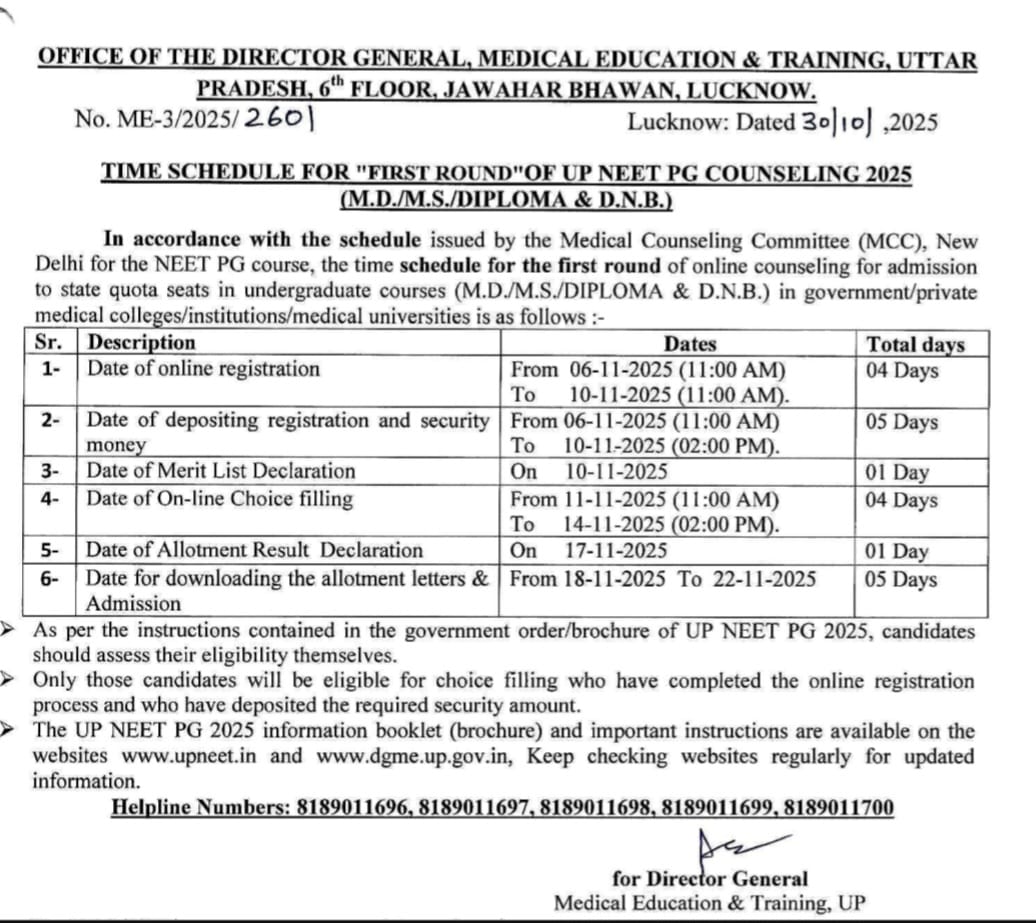
The second round of counselling (seat allotment) for MBBS in Uttar Pradesh under NEET‑UG is a crucial phase for many aspirants. After Round 1 allotment and reporting, some seats remain vacant (due to withdrawals, non‑joining, upgradation, etc.). Round 2 aims to fill those leftover seats and allow students to move to a better choice if eligible.
The 2nd round result is published by the UP DGME / counselling authority on the official portal. Candidates who get allotted a seat in Round 2 must complete document verification and reporting to the allotted college within the stipulated timeframe.
It’s important to understand that securing a seat in Round 1 does not guarantee immunity—if a student opts for upgradation or fails to report properly, they may lose the earlier allotment. Always refer to the UP counselling brochure or official notifications for exact rules.
Cutoff Criteria: Government vs Private Medical Colleges in UP
“Cutoff” in this context refers to the minimum marks or rank (or percentile) required for a candidate in a given category to secure admission in a particular college/course under a specific quota (state quota, all‑India quota, etc.)
1. NEET Qualifying Cutoff (Baseline)
Before any allotment, candidates must clear the NEET qualifying marks. As per NTA / the counselling norms for 2025:
| Category | Qualifying Percentile | Approx. Marks Range* |
|---|---|---|
| General / EWS | 50th percentile | ~ 686 – 144 |
| OBC / SC / ST | 40th percentile | ~ 143 – 113 |
| General‑PwBD | 45th percentile | ~ 143 – 127 |
| OBC / SC / ST – PwBD | 40th percentile | ~ 126 – 113 |
* These are indicative ranges; actual cutoffs vary by state, category, and competition.
Only after clearing this base threshold can a candidate be considered in the merit list for counselling.
2. State Quota (UP) Cutoffs for Government Colleges
In UP, 85% of MBBS seats are typically reserved under the State Quota for candidates who fulfill UP domicile / eligibility criteria. Only such candidates can compete for these seats.
Because government medical colleges are highly sought, their cutoffs tend to be high, especially for general category. In previous years, a general category candidate seeking a government MBBS seat in UP might need a very high NEET score (well above the minimum qualifying cut) to stand a chance. (Exact cutoff marks depend on the year, competition, number of seats, and reservation category.)
3. Private / Minority Colleges: Cutoff Considerations
Private medical colleges in UP admit students under a combination of quotas (management quota, NRI quota, state quota seats, institutional quota, etc.). Their cutoffs are generally lower compared to top government colleges, but still depend heavily on demand, reputation, fees, and category.
For private colleges, candidates from outside UP may also participate (depending on rules) under certain quotas, so the competition is broader.
The cutoff for private colleges may see wider variations: in less competitive categories or for leftover seats, lower marks may suffice; for high-prestige private colleges, the cutoff may remain quite high.
Also, private colleges may factor in additional criteria (e.g. donation, management quota), which can influence the effective cutoff beyond pure merit.
Because the private quota is less standardized, aspirants should check individual college / management quota rules, historical cutoff trends, and counselling brochures.
4. Round 2 Dynamics & Cutoff Movement
In Round 2, cutoffs can shift upward or downward depending on:
Which students from Round 1 surrender seats or upgrade,
How many seats remain vacant,
Fresh entrants (if allowed) who hadn’t participated in Round 1,
Demand for specific colleges or specialties.
Sometimes, students with mid-range scores may get better chances in private colleges in Round 2 if many high-score candidates have already secured seats.
Key Documents Required for UP MBBS Counselling & Admission
When reporting for allotment or document verification (after Round 2), candidates must present original documents along with self-attested copies. Below is a commonly required list (you should cross-check with the official UP DGME counselling brochure for the year in question):
NEET‑UG 2025 Admit Card / Hall Ticket
NEET 2025 Scorecard / Rank Card
Class 10 (Secondary) Mark Sheet & Certificate – often used to verify date of birth.
Class 12 (Higher Secondary) Mark Sheet & Pass Certificate (Physics, Chemistry, Biology, English)
Valid Photo ID Proof (Aadhar Card / Passport / Driving License / PAN Card)
Domicile Certificate (for candidates claiming UP state quota)
Caste / Category Certificate, if applicable (SC / ST / OBC / EWS)
Sub‑category / Disability (PwBD) Certificate, if applicable
Transfer Certificate (TC) / Migration Certificate, especially if moving from another board / institution
Recent Passport-size Photographs (as per specifications)
Allotment Letter (Seat allotment / admission letter downloaded from the counselling portal)
Security / Fee Payment Proof (receipt of security deposit or fee payment during counselling)
Gap / Affidavit Certificate, if there is a gap year (if required by state rules)
Character Certificate / Conduct Certificate (if required) – from last school/institution.
Important Tips:
All certificates should be from competent authority and in the format as prescribed by the UP DGME / counselling portal.
Caste / EWS certificates must generally be issued on or after the date specified by the authority (for example, after April 1, 2025).
If any document is missing or found invalid during verification, the candidate’s seat allotment may be cancelled.
Always carry additional sets of self-attested photocopies for each document.
Sample Flow of Round 2 Process & What Candidates Should Do
Check vacancy list: After Round 1 and reporting, the counselling authority publishes the list of vacant seats for Round 2.
Register / confirm participation: Some states require fresh registration for Round 2 (or to confirm willingness). In UP, candidates may need to register or opt-in for Round 2 if not automatically included.
Choice filling & locking: Candidates choose their preferred colleges (upgrades or new) and lock choices in the portal.
Seat allotment / result: Based on merit, category, and availability, seats are allotted in Round 2.
Download allotment letter and check allotted institute.
Document verification & reporting: Within stipulated dates (as per the notification), candidates must reach the allotted college (or nodal centre) with original documents for verification and admission confirmation.
Fee / security deposit payment: Pay required fees or deposit to secure the admission.
If dissatisfied / want upgrade: Depending on your state’s rules, if you want to attempt a better college in later rounds (Mop-Up / stray vacancy), you may participate in upgradation or withdrawal processes (if available) following the prescribed rules.
Final Notes & Advice for Aspirants
Always refer to the official counselling brochure / notification released by UP DGME (or the relevant authority) for the specific year; rules, fees, and dates may change.
Keep all documents organized and ready in original and photocopy forms.
Monitor the counselling portal regularly for updates (seat matrix, cutoffs, vacancy lists).
When filling preferences, be realistic yet ambitious; include safe and backup options.
Be mindful of deadlines for registration, choice locking, reporting, and withdrawal.
Even after Round 2, mop‑up and stray vacancy rounds may offer further chances—don’t lose hope until all rounds conclude.